What the course coversMaster course on the Internet of Things: sensor and actuator hardware, IoT infrastructure, the MING stack and the wireless protocols that connect devices.
Why the topic mattersBillions of connected devices exchange data every day; knowing their protocols is how computer scientists keep that infrastructure correct and secure.
Topics: Sensors and actuators, IoT infrastructure, MING stack, wireless communication protocols
What the course coversBachelor course that builds applications on the IoT stack: sensors, actuators, the MING stack and wireless protocols in practice.
Why the topic mattersApplications turn connected hardware into useful services, so they decide what the Internet of Things actually delivers.
Topics: Sensors and actuators, IoT infrastructure, MING stack, wireless communication protocols
What the course coversBachelor course on communication networks: the ISO/OSI layers, application protocols, TCP/UDP, IP, Ethernet and WiFi, plus network security.
Why the topic mattersEvery service, from email to cloud computing, rides on these protocols; they are the basic vocabulary of computer science.
The CV lists Summer 2023–2026 and Winter 2015–2018; the channel also has Winter 2025 playlists. Please confirm which institution each series belongs to.
Third-party content: clicking loads an embedded player from YouTube (youtube.com). Opens a single lecture video with the series playlist beside it.
What the course coversMaster course on securing networks: secure protocols, firewalls and intrusion detection, malware and countermeasures, secure computing and security in distributed systems.
Why the topic mattersAttacks on networked systems are the everyday reality of every organisation; defending them is a core professional skill.
Topics: Secure network protocols, firewalls and intrusion detection systems, malware and countermeasures, secure computing, security in distributed systems
What the course coversBachelor course on IT security: security terminology, cryptography, steganography, security models, attack strategies and data protection.
Why the topic mattersCryptography and data protection underpin everything from online banking to personal records, so security literacy is indispensable.
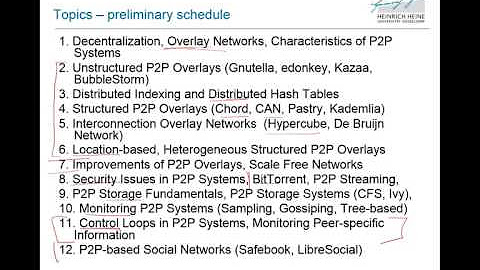
What the course coversMaster course on opportunistic and peer-to-peer systems: P2P overlays, storage, opportunistic networks and mobile communication.
Why the topic mattersPeer-to-peer and opportunistic routing show how data moves without central servers — relevant for resilient, privacy-preserving services.
Topics: P2P overlays, storage, opportunistic networks, mobile communication
What the course coversCourse on mobile communication systems: lower network layers, signalling, access control, wireless protocols and mobile ad hoc networks.
Why the topic mattersMobile networks keep people reachable; their lower layers decide bandwidth, latency and reliability.
Topics: Lower layers in communication networks, signalling, access control, wireless communication protocols, mobile ad hoc networks
What the course coversTelecommunication services and networks at the German-Kazakh University; the topics correspond to the communication-networks course.
Why the topic mattersTelephony and carrier networks still carry most real traffic; knowing their services matters for distributed systems work.
Topic wording derived from the CV focus areas, not from the playlist itself — please confirm or replace.
Project groupProject group, one yearExtent not stated in the CVSS/WS 23TH Bingen
Applying SCRUM in projects with companies
What the course coversProject group at TH Bingen: a lecture on Scrum plus supervision of student teams through six Scrum sprints.
Why the topic mattersIn real software projects coordination, not code, is the usual failure point — Agile methods are core professional practice.
Topics: Lecture on the Scrum software development process, supervision of student groups; the team was accompanied through six Scrum sprints.
No playlist found for this course.
Project groupProject group, one yearExtent not stated in the CVSS/WS 13/12, SS/WS 11University of Paderborn
A Peer-to-Peer / Distributed Framework for Social Networks
What the course coversYear-long project group at Paderborn: researching, implementing and evaluating P2P mechanisms for a framework of secure, decentralised social networks.
Why the topic mattersA working framework needs research and engineering together: students learn to build systems, not only study them.
Topics: Researching, implementing and evaluating P2P mechanisms for a framework of secure, decentralised social networks; project management, lectures, seminars, supervision.
No playlist found for this course.
Needs review
Not fully covered by the curriculum vitae — please confirm this entry.
Applications in IoT — The channel contains two playlists with the same title for this course; please confirm which one is the current series.
Communication Networks — The CV lists Summer 2023–2026 and Winter 2015–2018; the channel also has Winter 2025 playlists. Please confirm which institution each series belongs to.
IT Security — Two playlists cover this course with nearly identical titles; please confirm which one is the current series.
Mobile Communication Systems — The CV also lists Winter 2025 (Düsseldorf); no matching playlist was found on the channel.
Mobile Communication (MOKO) — Not listed in the CV lecture table (the CV lists Mobile Communication Systems at Düsseldorf only). No topic description was invented — please add one.
Cybersecurity — Playlist exists on the channel, but this lecture is not in the CV lecture table. Institution, level and topics need to be filled in.
Android Programming — Listed in the CV, but no matching playlist was found on the channel.
Telecommunication Services and Networks — Appears only in the German CV block; no playlist on the channel and no URL in the CV.
Guide for bachelor and master theses — Playlist title is channel content; not part of the CV lecture table. Please confirm the wording you want published.
Research on LibreSocial — Topic wording derived from the CV focus areas, not from the playlist itself — please confirm or replace.